There’s a voice that shows up after a good session. You know the one. The court felt right, the ball was jumping off the paddle cleanly, your movement had a rhythm to it — and so the voice says: don’t stop now. One more game. One more drill. Keep the momentum going. It’s a persuasive voice, and it disguises itself as discipline. But more often than not, it’s just noise.
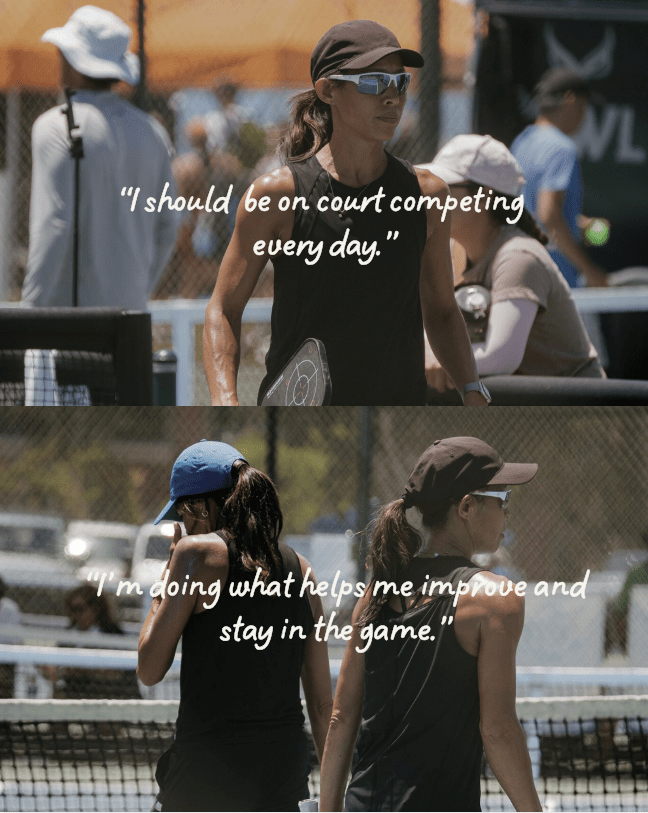
Last week I heard it. And I chose to stop anyway.
Not because I was exhausted. Not because the session had gone badly. But because something quieter in me knew that what I’d done was enough — that the best thing I could offer my game in that moment wasn’t more effort, but space.
The Story We Tell About More
We’ve grown up inside a particular story about improvement: that it comes from accumulation. More reps, more hours, more intensity, more sacrifice. And there’s truth in that story — you can’t grow without effort, without the willingness to show up and do hard things. But the story has a shadow side that doesn’t get talked about as much.
More, without recovery, doesn’t compound. It just accumulates as fatigue. The body that never rests doesn’t get stronger — it gets worn. The mind that never steps back doesn’t get sharper — it gets dull. At some point, “more” stops being the path forward and becomes the thing standing in the way.
At Ai Change, we come back to a different idea: that better is more important than “more”, and getting better requires understanding that training and rest aren’t opposites. They’re partners.
Where the Work Actually Settles In
What happens on the court is only half of what’s happening. The other half happens after — in the hours and days when you’re not playing, when your body is quietly doing the work of adapting, consolidating, rebuilding. The shot you drilled a hundred times doesn’t become instinct during the drill. It becomes instinct during the rest that follows.
This is what recovery actually is — not an absence of training, but a continuation of it. The body adapts in stillness. The nervous system integrates what it’s learned. The mental fatigue that accumulates under competitive pressure gets cleared away, so that next time you step on the court, you’re genuinely present rather than just physically there.
Without that space, you’re not building on what you’ve done. You’re carrying it forward as weight.
The Relationship with the Game
There’s something else that rest protects, and it’s harder to quantify but just as real: your relationship with the sport itself.
When you push without pause, the game can slowly shift in feeling. What started as something you love — the joy of movement, the pleasure of a well-played point, the connection with your partner on the court — can start to feel like an obligation. Like something you owe rather than something you get to do. That shift is subtle at first, and easy to ignore. But over time it becomes the difference between a practice that sustains you and one that drains you.
Stepping away, even briefly, creates the space to remember why you play. You come back to the court not just rested but reconnected — to the game, to your intention, to the simple pleasure of being out there.
Choosing to Stop as a Practice
For many of us, rest carries an uncomfortable feeling. Like we’re falling behind. Like the players who are still out there drilling are getting better while we’re standing still. That anxiety is worth examining, because it’s rarely about the game — it’s about a deeper discomfort with not doing, with trusting that enough is enough.
Choosing to stop when your body or mind needs it isn’t weakness. It’s a form of awareness that most players take years to develop. It’s the recognition that you’re in this for the long game — not just this session, not just this season, but the years of playing ahead of you. And sustaining that requires treating your recovery with the same care and intention you bring to your training.
The Long View
The players who stay in the game longest — who are still moving well, still improving, still genuinely enjoying themselves years down the road — aren’t the ones who trained the hardest in any given week. They’re the ones who learned how to build something sustainable. Who understood that the rhythm of growth isn’t constant intensity, but a thoughtful alternation between effort and ease, between pushing and allowing.
That’s the practice, in the end. Not just what you do on the court, but how wisely you care for yourself off it.
So the next time that voice shows up and tells you to do more — pause. Ask yourself what you actually need. Sometimes the answer will be to push. And sometimes the most intentional thing you can do is set the paddle down, walk off the court, and let the work of the day quietly do what it came to do.
Rest with intention. Play with love. 🤍✌🏼
 Living, Loving & Learning
Leave a comment